On my recent creative break I visited the Metropolitan Museum of Art in New York City. They have some beautiful statues there that I enjoyed admiring. Such grace and beauty.
View attachment 980539
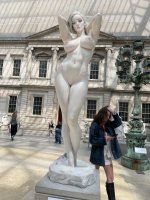
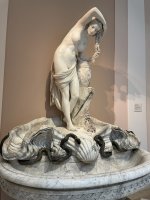
Evening - Frederick Wellington Ruckstull
Ruckstull intended “Evening” to portray an ideal, rather than a specific being. It illustrates his observation that “everything in nature folds at evening.” The voluptuous figure in a contrapposto stance, and her drowsy, distant expression suggests the approach of sleep.
View attachment 980540
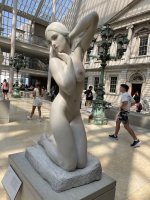
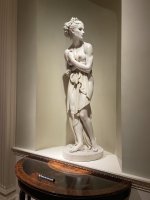
Fragilina - Attilio Piccirilli
Piccirilli carved an uncommissioned series of idealized female nudes. Fragilina is simplified, almost abstract, in form. The head is ovoid, with little articulation in the hair and face, and the eyes appear veiled in stone.
View attachment 980541
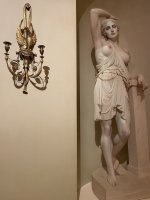
Marble statue of a wounded Amazon – Roman - 1st–2nd century CE
In Greek art, the Amazons, a mythical race of warrior women from Asia Minor, were often depicted battling such heroes as Herakles, Achilles, and Theseus. This statue represents a refugee from battle who has lost her weapons and bleeds from a wound under her right breast. Her chiton is unfastened at one shoulder and belted at the waist with a makeshift bit of bridle from her horse. Despite her plight, her face shows no sign of pain or fatigue. She leans lightly on a pillar at her left and rests her right arm gracefully on her head in a gesture often used to denote sleep or death. Such emotional restraint was characteristic of classical art of the second half of the fifth century B.C.
The original statue probably stood in the precinct of the great temple of Artemis at Ephesos.
View attachment 980542
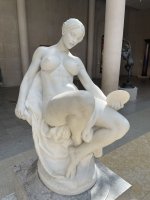
Memory - Daniel Chester French
For nearly fifty years, French included the allegorical female form in both his private and his public commissions. The sculptor focused on conveying life’s transience through symbolism: the motif of the mirror as well as the work’s title suggests that the figure (and, by analogy, the viewer) is ruminating on the ephemeral nature of beauty, youth, and life.
View attachment 980543
Nymph drying her hair - Louis Claude Vassé
Vassé's model for this figure was exhibited at the Salon of 1761. The wall fountain was completed between 1761 and 1763 at the behest of the Duc de Chevreuse for the entrance hall of his Château de Dampierre, where it remained until the early twentieth century.
View attachment 980544
Venus Italica - Workshop of Antonio Canova
Canova's first marble Venus is in the Palazzo Pitti, Florence. Known as the Venus Italica, it was ordered in 1804 by Ludovico I, King of Etruria, as a replacement for the ancient Medici Venus that had been taken by the French for the Musée Napoleon.